

 wellnessfitpro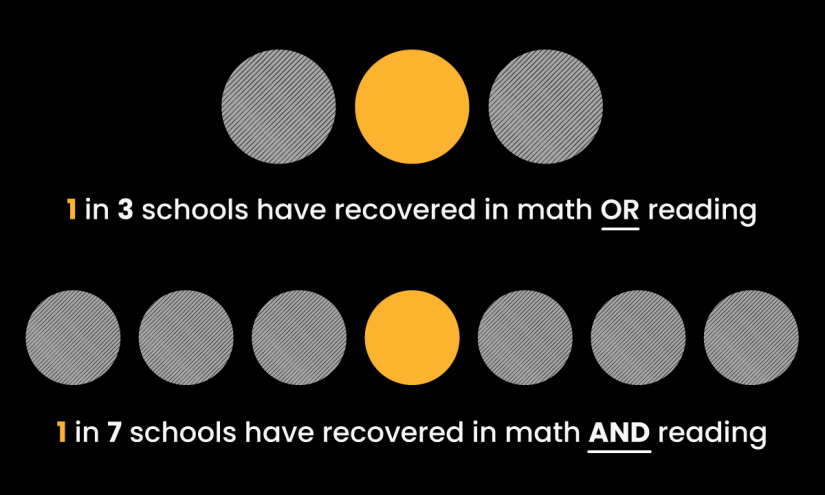
Get stories like this delivered straight to your inbox. Sign up for The 74 Newsletter
When the Pennsylvania Department of Education released reading scores in December, the news was grim. Not only was performance still far below pre-COVID levels, the percentage of students meeting expectations had fallen for a fourth straight year.
For Rachael Garnick, a former first grade teacher, the results were a reminder of how tough it’s been for schools to recover from historic declines in learning since the pandemic.
“The literacy scores are still abysmal and we should be displeased,” said Garnick, who heads the Pennsylvania Literacy Coalition. Made up of over 70 organizations, the group has pushed the legislature and state officials to fund and implement reading reform.
But despite the discouraging statewide results, she also sees districts, like Scranton in northeastern Pennsylvania and the Mohawk Area district, northwest of Pittsburgh, “trending in the right direction,” and demonstrating urgency over reading scores. Their attitude, she said, was “the opposite of ‘If it ain’t broke, don’t fix it.’ Instead, ‘It’s broke; we’ve got to fix it.’ ”
A recent report on pandemic learning loss from NWEA, an assessment company, captured that combination of frustration and hope over the state of academic recovery. About a third of schools have reached pre-COVID performance levels in reading or math, and just 14% have recovered in both subjects. But even some that were hit the hardest, like high-poverty schools, have made impressive gains.
The report was just the latest collection of results pointing to a long road ahead for most schools. Last year’s National Assessment of Educational Progress scores showed students in the majority of states losing more ground, but included a few standouts with strong progress, like Louisiana in reading and Alabama in math. And state test scores tell a similar story: few have topped pre-COVID performance.
It’s not like experts didn’t predict a slow recovery.
“If student performance improvement follows historical prepandemic trends, it could take decades for students to fully catch up,” researchers with McKinsey and Company, a consulting firm, wrote in 2023.
Even the nation’s education chief isn’t expecting good news soon.
“I would like to say that NAEP scores, when they come out again in January 2027, are going to show marked improvement,” Education Secretary Linda McMahon said in a recent K-12 Dive interview. “I don’t think they are.”
But Dan Goldhaber, director of the Center for Analysis of Longitudinal Data in Education Research, said it’s important to put NWEA data, and all measures of kids’ learning, in context.
“One of the reasons that we’re not seeing recovery and that the results aren’t better is because of what was happening in the decade before the pandemic,” he said. “There was a slow degradation of academic achievement.”
Resisters and rebounders
Schools that were able to resist further declines during the pandemic are those that are more likely to be back on track, according to NWEA’s data, which represents five million students who took the MAP Growth tests through fall 2024. Such schools make up nearly three quarters of the recovered schools.
The Los Angeles-area Compton Unified School District is one example.

Before the pandemic, the high-poverty, majority Latino district was already seeing gains on state assessments. When testing resumed in 2022, reading scores held steady. Math scores caught up the following year, and the district has continued to post gains ever since.
Superintendent Darin Brawley highlighted a mix of academic routines, like a math problem of the day, weekly quizzes and challenging writing assignments, that the district continued despite the disruption of school closures. Teachers were encouraged to dial back their use of smart boards in the classroom and require students to keep math and language arts journals to improve retention.
“Everything was being done on the smart board and kids weren’t notating anything,” Brawley said. “Certain things have to be worked out on paper.”
NWEA data also pointed to what the researchers call “rebounder” schools, those that saw significant drops in achievement but have been able to climb their way back. High-poverty schools are among those with impressive gains, but even districts seeing higher-than-ever performance still struggle to close wide achievement gaps.

“We’ve never had scores this high in English language arts or math,” said Buffy Roberts, associate superintendent of the Charleston County schools in South Carolina. “It’s been quite phenomenal.”
She was talking about state exams, which, unlike NWEA and NAEP, aren’t comparable because states don’t all measure proficiency the same. But they can still reflect post-COVID trends if states haven’t changed their tests since 2019.
South Carolina’s math test has remained constant. Results show that statewide, scores have nearly recovered. It’s a trend that NWEA noted as well, explaining that while schools “lost significant ground,” in math, many made “substantial gains afterward.”
In Charleston, 54% of students in grades three through eight met or exceeded expectations in math last year, up from 48% in 2019 and about 10 percentage points higher than the state average. The district also made the Harvard Center for Education Policy Research’s list of 100 fully recovered districts in the nation last year.
Roberts pointed to a swift return to in-person instruction and high-dosage tutoring as some of the factors contributing to strong growth. But she said at the outset of the pandemic, leaders “knew there were some vulnerable groups” that would need “structures and support to mitigate some of that learning loss.”
The district’s funding formula, she explained, provided extra dollars to schools with high-poverty students even when the schools didn’t qualify for federal Title I funding. The schools used the funds for extra staff to reduce class sizes, incentives to increase attendance and mental health services.
But there’s still a lot of work to do. In fourth grade math, there’s a more than 50 percentage point gap between white and Black students, and students from wealthier families outscore students in poverty by 39 percentage points.
“We agree that progress must be faster,” the district posted on Facebook after a conservative community group drew attention to the disparities.

In an analysis of 2025 state test scores, Education Data Center researchers, led by Brown University’s Emily Oster, were hopeful about continued math recovery in 2026. Of the 32 states that have kept the same math test since before COVID, seven met or exceeded 2019 proficiency rates: Colorado, Georgia, Iowa, Mississippi, Missouri, Rhode Island and Tennessee.
But even if they didn’t, they all made some gains. Despite Pennsylvania’s decline in reading, for example, its performance in math is less than a percentage point from reaching the 2019 level.
But the results in reading were less encouraging. Six out of 28 states have met or surpassed pre-pandemic performance. But several others, like Massachusetts, Minnesota and Oregon, remain well off that mark.
Goldhaber, with CALDER, suggested that states haven’t seen improvement on tests because parents trust those scores less than the grades kids bring home on report cards and assignments.
A recent University of Chicago paper reiterated that point. In a survey of over 2,000 parents, nearly three quarters said they believe grades more than tests when making decisions about their children’s learning. They’re also less likely to take action, like seeking out tutoring or other help for their child, when grades are good.
The problem is that because of grade inflation, which was on the rise even before the pandemic, grades are a less accurate measure of how students are really doing.
The results of that survey were no surprise to Bibb Hubbard, founder and CEO of Learning Heroes, a nonprofit that focuses on helping parents understand achievement data. She said she’s been “screaming from the rooftops for 10 years” that parents are missing important messages about their kids’ performance.
“Good grades do not equal grade level,” she said. “Parents are deeply engaged, but we can’t afford to leave them on the sidelines relying on grades alone. The stakes are too high.”
Did you use this article in your work?
We’d love to hear how The 74’s reporting is helping educators, researchers, and policymakers. Tell us how
News,Brown University,Charleston,Compton,education,k-12,learning loss,Linda McMahon,National Assessment of Educational Progress,NWEA,PennsylvaniaNews,Brown University,Charleston,Compton,education,k-12,learning loss,Linda McMahon,National Assessment of Educational Progress,NWEA,Pennsylvania#National #State #Data #Point #Slow #Pace #Pandemic #Recovery1773052983

