

 wellnessfitpro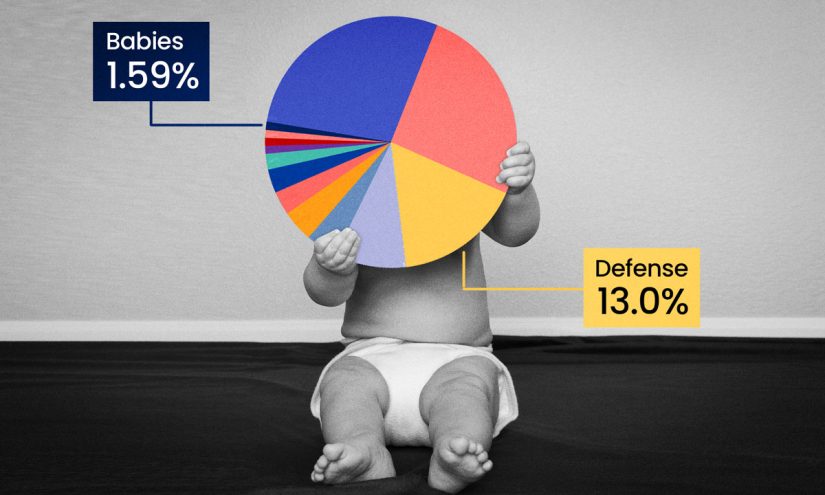
The United States devotes a minuscule portion of its federal spending to the nation’s babies.
In fiscal year 2025, 1.59% of all federal spending was dedicated to supporting children from birth to age 3, down about 20% from its peak of 1.98% in 2021, when adjusted for inflation.
That’s according to Babies in the Budget, an annual report from First Focus on Children, a nonprofit, bipartisan advocacy organization that seeks to elevate children and families in federal policy and budget decisions.
For the 2025 edition, the authors tracked nearly 150 federal programs that invest in infants and toddlers, including mandatory programs such as Medicaid and SNAP and discretionary programs such as the Child Care and Development Fund, Head Start and Preschool Development Grants. Their findings, they said, confirm that the U.S. can and should be doing a lot better when it comes to babies.

And with major funding cuts to Medicaid and SNAP looming — programs which help to meet the basic needs of America’s youngest population and make up about half of all federal spending on babies — the next few years are only expected to be worse.
“All the research shows this is the best investment you can possibly make for any age group, and yet we shortchange it,” said Bruce Lesley, president of First Focus and one of the report’s authors. “We make far fewer investments for kids — but particularly babies and toddlers — than we actually should be making.”
Is there a magic number of dollars to invest in young children? In an interview, Lesley and his co-authors said no. But they did note that while the world’s largest economy spends $1.59 out of every $100 on babies, it spends about $13 on defense.
Lesley also pointed out that children from birth to age 3 make up about 3.26% of the U.S. population, meaning federal spending on them is not even half of their population share. And some would argue that infants and toddlers, being an especially vulnerable, wholly dependent group, warrant more than their fair share of spending.
“Many things about human infants and toddlers are expensive,” said Elizabeth Gaines, founder and CEO of Children’s Funding Project, a nonprofit that works with states, communities and Native nations to support and expand funding for children. “They’re vulnerable creatures. We should be spending more of our resources on the most vulnerable of us.”
Many countries have better infrastructure for supporting children and families than the U.S. does, said Melissa Boteach, chief policy officer at Zero to Three, a national nonprofit advocating for infants and toddlers. Most have paid family and medical leave and universal health care systems, which the United States does not provide. That leaves many populations, including the youngest, to fend for themselves.
“It’s paltry,” Boteach said of federal investment. “Babies are 100% of the future. They’re in a period where their brain development is so rapid, the investments have such a long-term impact, and yet we continue to underinvest in babies.”
While overall spending on babies is down about 20% over the past four years, discretionary spending has fared even worse. Since 2021, investment in programs that support child care, early learning, environmental safety and health for babies has declined by more than half — from 2.05% in 2021 to 0.96% in 2025.

Many of these programs received historic levels of funding in 2021 as part of the American Rescue Plan Act, in response to the pandemic, making it an outlier year, acknowledged Chris Becker, vice president of budget policy and data analysis at First Focus and an author of the report. As a result of all that spending, he said, the child poverty rate in the U.S. was slashed in half in 2021, lifting nearly 3 million children out of poverty and illustrating what could be possible if the nation invested more in its youngest citizens.
“Child poverty exists. Food insecurity exists for babies. Homelessness exists for babies,” Becker said. “I don’t know what number solves that, but it is solvable.”
H.R. 1, also referred to as the “One Big Beautiful Bill Act,” which was signed into law by President Donald Trump in July 2025, may only increase the child poverty rate in the country, the authors of the Babies in the Budget report said. The legislation includes an estimated $1 trillion in cuts to Medicaid and SNAP, which will gut the largest sources of federal spending on children from birth to 3. It will then be up to individual states to decide whether to make up the cost difference in those programs or let benefits lapse.
Trump has cast himself as a “pro-family” president, promoting pronatalist rhetoric about boosting birth rates and supporting parents — a message amplified by Vice President JD Vance and other allies. But the legislation tells a different story: Federal investment in babies and toddlers remains limited, and the largest funding streams for young children face steep cuts.
“I don’t even like to think about what is going to come from SNAP and Medicaid cuts,” said Gaines of Children’s Funding Project. “Kids in states that step up may end up being OK. Kids from states that largely voted this administration into office may not be OK.”
The president’s proposed budget for 2026 — though not in any way binding and merely used as a blueprint so Congress can see what the administration wants to prioritize — included program and funding cuts across the board, said Becker of First Focus. But “babies are hit especially hard,” he said, with proposed elimination of dozens of programs serving babies and a reduction of more than $2.5 billion in discretionary spending.
There is a dichotomy between the administration’s words and actions on children and families, added Boteach.
“Budgets are moral documents,” she said. “Show me your budget, and I’ll tell you what your priorities are. You can say your priorities are whatever you want, but the words are empty if they’re not reflected back in a document that actually puts resources into what you say your priorities are.”
Some leaders in the Trump administration have argued these programs for children are too costly, but Gaines doesn’t accept that as an answer.
“The resources are there. This is a nation of abundance,” said Gaines. “When people say the money is not there — it clearly is. Choices are being made about where we invest our dollars publicly.”
To illustrate her point, she noted that the One Big Beautiful Bill Act included a $45 billion expansion of immigrant detention facilities. In 2021, the federal government spent $39 billion on child care relief, and it was transformative for the field, she said.
“I think if we asked the public whether they want their money on ICE detention centers or child care centers,” Gaines added, “they’d say child care centers.”
Did you use this article in your work?
We’d love to hear how The 74’s reporting is helping educators, researchers, and policymakers. Tell us how
News,babies,Early Childhood,Early Childhood Funding,FamiliesNews,babies,Early Childhood,Early Childhood Funding,Families#Americas #Babies #Tiny #Slice #Federal #Budget1773060423

